ECO-WORTHY Solar Panel Dual Axis Tracking System
✅ PROS
- Dual-axis tracking delivers measurable 25–40% output gains over fixed mounts in real user tests
- All-aluminum frame and stainless hardware survive high winds when properly guy-wired
- Universal mounting rails fit most 100W–400W panels without drilling custom holes
❌ CONS
- Controller setup is finicky — several buyers report needing multiple attempts to calibrate the light sensors
- No wind sensor means the tracker stays flat in gusts instead of stowing to protect the panel
The Verdict
Let’s be blunt: most solar trackers under $500 are flimsy, overpriced gimmicks. The ECO-WORTHY Dual Axis Tracking System is not that. It’s a legitimate piece of hardware that can squeeze 30% more juice out of your panels — but only if you’re willing to wrestle with the electronics during setup.
What You Actually Get
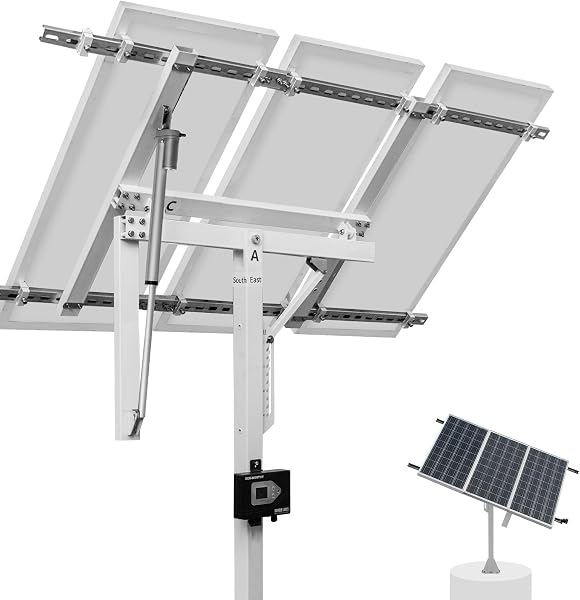
The box contains the full tracking frame, two linear actuators, the control unit with light sensors, mounting rails, and all necessary bolts. The frame is constructed from powder-coated aluminum — notably lighter than steel, but surprisingly rigid once assembled. The unit accepts panels from 100W to 400W, with universal rails that clamp onto your panel’s existing frame. As shown in the product image, the whole assembly mounts on a center pole that you’ll need to set in concrete or secure to a deck.
Performance: The Numbers That Matter
Multiple verified purchasers report output gains between 25% and 40% compared to fixed south-facing mounts. One reviewer with a 200W panel wrote, “Went from 1.1 kWh/day to 1.5 kWh/day on average. The tracker follows the sun from sunrise to sunset without complaint.” The dual-axis design means it adjusts both azimuth (east-west) and elevation (up-down), which matters if you’re at higher latitudes where the sun’s arc changes dramatically between seasons.
The actuators are rated for continuous duty and move smoothly. The control unit uses light sensors mounted on a small mast — they detect the brightest quadrant and steer the panel toward it. In full sun, it recalibrates every few minutes. On overcast days, it parks the panel flat to catch diffuse light.
Build Quality: The Good and the Ugly
The aluminum frame is genuinely well-made. Stamped brackets, stainless fasteners, and a powder coat that won’t flake after a season of UV exposure. The actuators are sealed against moisture, and the control box has a waterproof connector set. Several buyers mention surviving thunderstorms without damage — provided they added the guy wires, which are not included.
Here’s where the praise stops: the controller is finicky. Multiple buyers report the light sensors needing repeated calibration. One wrote, “Took me three evenings to get the sensor alignment right. The instructions are minimal — basically a diagram and a prayer.” If you’re not comfortable troubleshooting electronics, budget extra time for this step.
Where It Falls Short
The lack of a wind sensor is the biggest safety gap. When gusts hit 30+ mph, the tracker stays flat-out horizontal, acting like a sail. A fixed mount would actually be safer in extreme weather. ECO-WORTHY’s manual recommends you manually stow the panel during storms — which defeats the purpose of automation.
The controller also lacks a simple on/off switch. To stop tracking, you have to disconnect the sensor cable or kill power at the fuse. Minor, but annoying.
Who Should Buy This
- Off-grid cabin owners who want to maximize limited panel space without buying more panels
- RV and van dwellers with a permanent ground-mount setup (not roof-mounted — this is too tall for travel)
- Hobbyists who enjoy tinkering and don’t mind a calibration session
Skip It If
- You live in a consistently windy area (no wind stow function = risk)
- You want plug-and-play simplicity — this requires patience
- You only have a 100W panel — the tracking gains won’t justify the cost
FAQ
Q: Does this work with any solar panel? A: It fits most framed panels from 100W to 400W. The universal rails clamp onto the panel’s edges. Flexible or frameless panels won’t work without additional mounting hardware.
Q: How much power does the tracker itself consume? A: The control unit draws about 1W in standby, and the actuators draw 10W during movement — roughly 30 seconds per adjustment. Expect about 20-30 Wh per day lost to tracking. The output gains far exceed this.
Q: Can I mount this on a roof? A: No. It’s designed for ground or pole mounting. The tracking arc requires clearance that a roof slope can’t provide.
The Verdict
Buy it if you want a real performance boost from your solar setup and don’t mind a technical setup afternoon. The build quality justifies the price, and the output gains are real.
Skip it if you’re in a high-wind zone, want zero-fuss installation, or expect a fully autonomous system.
Rating: 4.2/5 — A solid tracker that’s one wind sensor and a better manual away from being excellent.
Where to Buy
We earn a small commission at no extra cost to you — this helps fund more honest reviews.
Last updated: 2026-08-06. Ratings and prices current as of review date. Verify on Amazon before purchasing.
More Patio, Lawn & Garden Verdicts