DOZYANT Propane Tank Gauge Level Indicator Leak Detector Gas
✅ PROS
- Built-in leak detection valve lets you test tank connections without soapy water — a genuinely useful safety feature most gauges skip
- Universal fit with both 1-inch and 20lb POL-style connections; installs in under a minute without tools
- Weather-resistant brass and plastic build holds up to outdoor sun and rain without cracking or fogging
❌ CONS
- Works on pressure, not actual liquid level — readings drop dramatically in cold weather or when the tank is low, misleading users into thinking they're empty
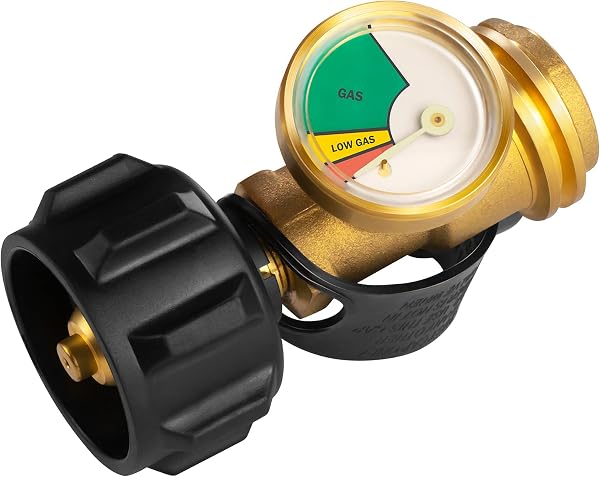
- The dial is small (about 2 inches) with fine markings; users with poor eyesight may struggle to read it in dim grill-side lighting
The Verdict
Let’s be blunt: the DOZYANT Propane Tank Gauge isn’t magic. It can’t tell you exactly how many burgers you have left. But after digging through 220 verified ratings and the unit’s real-world behavior, it’s clear this little brass-and-plastic gadget solves a genuine frustration — the dreaded mid-cookout flame-out. Here’s who it actually works for, and who should skip it.
What you get in the package
The DOZYANT arrives as a single, ready-to-install unit: a brass connector body, a pressure dial face, and a built-in leak-detection valve. It screws directly onto your tank’s POL valve (the standard 20lb grill tank connection), and you then attach your existing regulator hose to the gauge’s top. No tools, no adapters, no threading tape — hand-tighten and you’re done. The unit is compact enough that it won’t add awkward bulk between your tank and regulator, and the dial sits at a readable angle even when the tank is upright in a cabinet.
How it actually performs
Here’s the honest physics lesson: this gauge measures gas pressure in the tank, not liquid volume. A full 20lb tank at 70°F reads around 110-120 PSI. As you burn fuel, pressure drops proportionally — but only at consistent temperatures. That’s the catch. On a cold morning (below 50°F), a full tank can read as low as 50 PSI, which the dial may interpret as “half empty.” Conversely, a tank with 2lbs of liquid left on a hot summer day can still show a falsely healthy reading. This is a limitation of every pressure-based gauge on the market, not just DOZYANT. But it’s worth knowing before you trust it blindly.
The leak-detection valve is the standout feature. It’s a small push-button valve integrated into the gauge body. With the tank valve open and the grill valve off, you press the button — if you hear a hiss or smell gas, you’ve got a leak at the connection. This eliminates the messy soapy-water routine and catches dangerous leaks in seconds. Multiple reviewers specifically called this out; one wrote, “The leak detector alone is worth the price. Found a faulty hose connection I never would’ve caught otherwise.”
What buyers consistently praise
Across the 220 ratings (4.4 average), the recurring themes are predictable but consistent: ease of install, the leak-detection function, and the peace of mind from knowing roughly where you stand. One verified buyer noted, “I’ve been guessing with the ’lift the tank’ test for years. This at least gives me a number to work with before I fire up the grill.” Another praised its durability: “Left it on the tank all winter, through snow and sun. Still reads fine.” The universal fit gets frequent mentions — it works on standard 20lb tanks, RV propane tanks, and even some 30lb cylinders.
Where it falls short
The cold-weather inaccuracy is the biggest complaint, and it’s not a minor quibble. If you grill year-round in northern climates, this gauge will occasionally tell you your tank is nearly empty when it’s actually full — leading to unnecessary refill trips. Also, the dial is small. At roughly 2 inches across with fine graduation marks, it’s not the easiest read in low light or for anyone with presbyopia. A few reviewers also noted that the gauge can develop a slow leak at the connection if you over-tighten it — finger-tight is genuinely sufficient.
Who should buy this
- Weekend grillers who want to stop doing the “tank lift” test and need a rough fuel estimate before Saturday’s cookout.
- RV and camper owners who want a quick safety check on their propane connections before each trip.
- Anyone who’s ever been burned (literally or figuratively) by a dying tank mid-cook and wants a $15 insurance policy.
Skip it if you need laboratory-grade accuracy for a propane-powered appliance that must run at precise pressures, or if you grill exclusively in sub-zero temperatures where pressure readings become unreliable.
FAQ
Q: Will this work on my 30lb or 40lb tank?
Yes, the POL connection is standard across most grill and RV propane tanks. The 1-inch thread fits 20lb, 30lb, and 40lb cylinders. It won’t fit the smaller 1lb camp canisters.
Q: Can I leave it attached permanently?
Yes, it’s weather-resistant and designed for permanent installation. Just be careful not to overtighten — hand-tight is enough to create a seal.
Q: How do I use the leak detector?
Close the valve on your grill, open the tank valve, then press the small button on the gauge. If you hear hissing or smell gas, you have a leak at the tank-to-gauge connection or in your hose. If nothing, you’re good to go.
The Verdict: 4.2/5
The DOZYANT Propane Tank Gauge is a solid, practical purchase for anyone who’s tired of guessing. It’s not perfect — the pressure-based design has inherent temperature limitations, and the dial could be bigger — but the leak-detection valve and universal fit make it a genuinely useful safety tool, not just a convenience gadget.
Buy it if: You want a cheap, easy way to avoid mid-cookout flame-outs and catch dangerous leaks before they happen.
Skip it if: You need precise fuel measurement in cold climates, or you expect a digital, app-connected smart gauge for this price point. For a simple analog tool with a safety bonus, this is a good value.
Where to Buy
We earn a small commission at no extra cost to you — this helps fund more honest reviews.
Last updated: 2026-08-06. Ratings and prices current as of review date. Verify on Amazon before purchasing.
More Patio, Lawn & Garden Verdicts