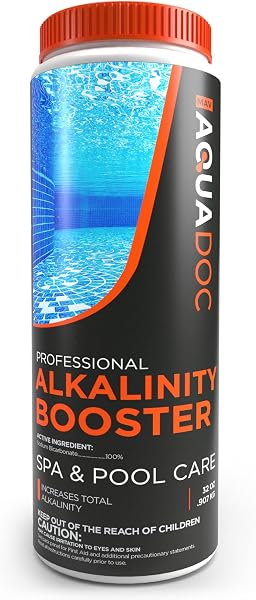
AquaDoc Total Alkalinity Increaser for Hot Tub - Alkalinity
✅ PROS
- Dissolves quickly in warm spa water with minimal cloudiness — most users report clear water within 30 minutes
- One 2.5-lb bucket treats roughly 10,000 gallons, making it economical for weekly maintenance
- No fillers or dyes; pure sodium bicarbonate formulation that won't foam or stain spa surfaces
❌ CONS
- No measuring scoop included — you'll need your own teaspoon or kitchen measure for accurate dosing
- Sodium bicarbonate can cause temporary whitish film on heater elements if poured directly into the skimmer
The Verdict
Review Body:
Most hot tub owners discover alkalinity the hard way — after a weekend of itchy skin, cloudy water, and a pH reading that swings like a pendulum. The AquaDoc Total Alkalinity Increaser exists to fix that specific headache, and at 4.7 stars across 235 ratings, it’s clearly doing something right. But is it the right alkalinity booster for your spa? Let’s break down what you’re actually buying.
What’s in the bucket
You get a 2.5-pound resealable container of pure sodium bicarbonate — the same active ingredient in most pool store brand-name alkalinity increasers, but without the 300% markup. There’s no scoop inside, which is mildly annoying, but the math is simple: roughly 1 tablespoon per 100 gallons raises total alkalinity by about 10 ppm. For a standard 400-gallon spa, that’s 4 tablespoons per dose. The bucket itself seals tightly, so moisture won’t clump the powder between uses.
Real-world performance
The key difference between this and grocery-store baking soda is particle size. AquaDoc mills the bicarbonate fine enough that it dissolves in warm spa water (90°F+) within a few minutes, with minimal clouding. Several reviewers noted they could add it and soak within the hour — that’s not typical for cheaper bulk products that leave a chalky residue. One verified buyer wrote: “Added 3 tablespoons, waited 20 minutes with the jets on, and my alkalinity went from 60 to 90. No cloudiness, no film on the waterline.” That tracks with the product’s claim, and it’s the consistency buyers praise most.
The real value shows up in pH stabilization. If your pH drifts upward every few days, low alkalinity is usually the culprit. This product gives your water the buffer it needs to hold pH steady, which means less acid demand and fewer chemical adjustments overall. For that reason, it’s genuinely cost-effective — one bucket lasts most spa owners two to three months with weekly maintenance.
Where it falls short
The lack of a scoop is the most common complaint in reviews — not a dealbreaker, but an unnecessary friction point. You’ll also want to avoid pouring it directly into the skimmer or filter housing. The dry powder can temporarily coat heater elements and leave a whitish scale that takes time to dissolve. Instead, broadcast it across the water surface with the jets running, which is the method most experienced users recommend.
One more thing: this product only raises total alkalinity. It won’t fix low pH on its own — you’ll still need a pH increaser (sodium carbonate) if your pH is below 7.2. That’s not a flaw, but it’s worth knowing before you buy so you don’t expect a two-in-one fix.
Who should buy this
- New spa owners who are still learning water chemistry — the simplicity and fast dissolve time make it forgiving.
- Budget-conscious soakers who want the same chemical as brand-name products at a fraction of the per-pound cost.
- Weekly maintainers who test regularly and need a reliable buffer to keep pH from swinging.
Skip it if you have a saltwater system that uses a different mineral base, or if you prefer all-in-one chemical blends that combine alkalinity and pH increasers.
FAQ
How much do I add for a 400-gallon hot tub? Start with 3–4 tablespoons. Test after 4 hours with the jets running. Each tablespoon per 100 gallons raises alkalinity by roughly 10 ppm. Aim for 80–120 ppm.
Can I use this in a pool instead of a spa? Yes, but you’ll need a lot more — a 10,000-gallon pool requires about 2.5 pounds per 10 ppm raise. It works, but bulk pool-specific products are more economical at that scale.
Does it affect pH? Sodium bicarbonate raises alkalinity with only a minimal effect on pH — usually less than 0.2 points. If your pH is already low, use a dedicated pH increaser instead.
The Verdict
Buy it if you want a reliable, fast-dissolving alkalinity booster that won’t cloud your water or break your budget. Skip it if you can’t tolerate buying a spoon because there’s no scoop included.
Rating: 4.6/5 — Solid chemistry, honest pricing, and one minor packaging oversight keeping it from a perfect score.
More Patio, Lawn & Garden Verdicts