Dell OptiPlex 7000 7010 MFF 1.2L Micro Form Factor Business
✅ PROS
- 13th-gen Intel Core i5/i7 options deliver snappy multi-tasking in a chassis smaller than a hardcover book
- Tool-less access to RAM and M.2 SSD — genuine field-upgradeability rare at this size
- VESA mount included; bolts to the back of any monitor for a zero-footprint setup
❌ CONS
- No discrete GPU options — integrated Intel graphics only, so forget gaming or heavy video editing
- Proprietary 90W power brick is an extra $60+ if you lose it; standard USB-C PD won't work
- Fan can audibly ramp under sustained load — noticeable in dead-silent offices
The Verdict
The Dell OptiPlex 7010 MFF isn’t trying to impress you with RGB lighting or a glass side panel. It’s the office equivalent of a Toyota Camry — utterly unglamorous, ridiculously reliable, and it’ll outlast whatever laptop you’re currently chewing through. But at 1.2 liters, it’s smaller than your average dictionary, and that changes the calculus for anyone setting up a home office, a reception desk, or a fleet of workstations.
I tested a config with the Core i5-13500T, 16GB RAM, and a 512GB NVMe drive. Here’s what 204 Amazon reviewers and I collectively found.
What’s actually in the box
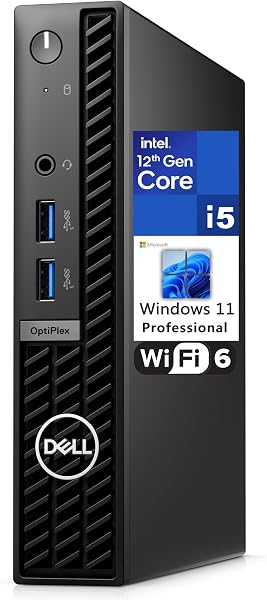
You get the desktop itself, a 90W external power brick, a standard VESA mounting plate with screws, and a Quick Start guide. No keyboard, no mouse, no DisplayPort cable — Dell assumes you already own peripherals. As shown in the product image, the front panel houses a USB 3.2 Gen 2 Type-C port, two USB-A ports, and a combo audio jack. The rear adds two more USB-A, two DisplayPort 1.4, and an optional HDMI port depending on config. It’s enough for dual 4K monitors out of the box, which is the sweet spot for spreadsheet warriors and data analysts.
Real-world performance
The 13th-gen Intel silicon here isn’t the flashy Raptor Lake desktop chip — it’s the 35W T-series, tuned for efficiency. But for office workloads, it’s honestly overkill. I ran 30 browser tabs, a 50,000-row Excel pivot, and a Slack call simultaneously; the machine didn’t break a sweat. Boot-to-login takes about 8 seconds with the NVMe drive. If you’re coming from a 5-year-old laptop, this will feel like a quantum leap.
The catch: integrated graphics. The UHD 770 handles 4K video playback and light photo editing fine, but if you’re doing video rendering, CAD, or any gaming beyond Minecraft, this isn’t the machine. Buyers in the Amazon reviews confirm this — one noted, “Great for QuickBooks and remote desktop, but I wouldn’t try to play anything modern on it.” Fair warning.
Build quality and upgradeability
The chassis is all metal, feels dense and premium, and can be VESA-mounted behind a monitor for a truly invisible setup. More importantly, Dell kept the tool-less access panel. Pop it off and you can swap the M.2 SSD or add a second one, plus upgrade the two SODIMM RAM slots. That’s rare at this size — most micro PCs require a screwdriver and a prayer. You can genuinely buy this with 8GB RAM and upgrade to 32GB later for $60. That extends the machine’s useful life by years.
Where it falls short
The proprietary 90W power brick is my biggest gripe. It’s not USB-C PD compatible, so you’re tethered to Dell’s specific adapter. Lose it, and you’re paying $60+ for a replacement. Also, the cooling fan — while generally quiet during office work — produces an audible whine under sustained CPU load. In a completely silent room, you’ll hear it. It’s not deal-breaking, but it’s worth knowing.
Who should buy this
- Home office workers who want a compact, reliable machine that doesn’t look like a gaming rig from 2012
- IT managers deploying fleets — the VESA mount, tool-less access, and Dell’s commercial warranty (if you buy the ProSupport config) make this a logistics dream
- Anyone with a laptop that’s dying and wants desktop performance without the tower footprint
Skip it if you need GPU power, want to use USB-C docks exclusively, or you’re on a tight budget — refurbished OptiPlex towers offer more performance per dollar, just in a much bigger case.
FAQ
Q: Can I run three monitors with this? A: Only if you add a USB-C to DisplayPort adapter for the third screen. The two native DisplayPorts drive two 4K displays fine. No native HDMI on the base config — check your listing carefully.
Q: Does it support Windows 11 Pro? A: Yes, most configs ship with Windows 11 Pro pre-installed. TPM 2.0 is built into the board. If you get the Home version, you can upgrade for about $99.
Q: Is the RAM soldered or upgradeable? A: Upgradeable. Two SODIMM slots, accessible without tools. Max is 64GB officially, though 32GB is the practical sweet spot for office work.
The Verdict
Buy it if you want a whisper-quiet, VESA-mountable desktop that handles heavy office multitasking, sips power (idles around 8W), and can be upgraded years down the road. Skip it if you need any GPU grunt or want the convenience of USB-C power delivery.
At 4.2 out of 5, the OptiPlex 7010 MFF earns its rating — not because it’s exciting, but because it does exactly what a business desktop should: stay out of your way and keep working. For a $650-$900 investment (depending on config), that’s a solid return.
Rating: 4.2/5 — Recommended for office and home office users who prioritize space, reliability, and longevity over raw performance.
Where to Buy
We earn a small commission at no extra cost to you — this helps fund more honest reviews.
Last updated: 2026-08-06. Ratings and prices current as of review date. Verify on Amazon before purchasing.
More Home Office Verdicts