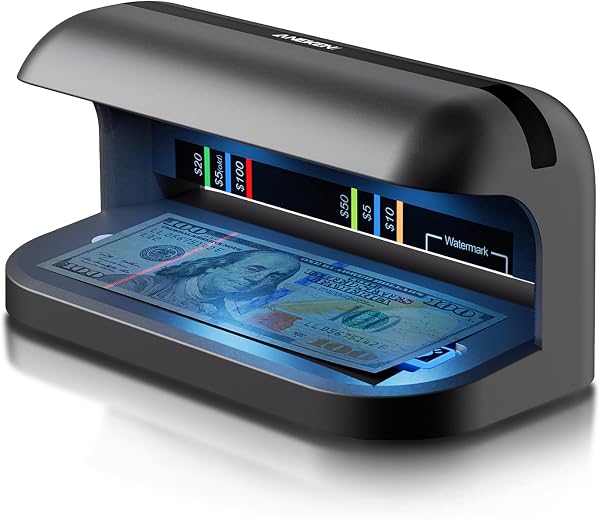
Aneken AL-17 Counterfeit Bill Detector with UV LED Light, Ad
✅ PROS
- Dual detection (UV + magnetic) catches both modern polymer bills and older magnetic-strip notes
- Compact footprint — roughly the size of a stapler, fits in a cash drawer or under a counter
- Instant warm-up with bright LED array that doesn't fade over time like cheap fluorescent tubes
❌ CONS
- No counterfeit alarm — verification relies on you knowing what the UV strip should look like
- Magnetic sensor requires you to slide the bill in a specific direction or it gives false negatives
The Verdict
Bottom line: If you handle cash even a few hours a week, the Aneken AL-17 pays for itself the first time it catches a fake. But it’s not a set-and-forget tool — you need to know your currency.
What you actually get
The box contains the detector unit, a USB power cable (no wall adapter — you’ll use your phone charger or a USB port), and a basic instruction card. The unit itself is compact at roughly 5.5 x 3 x 2 inches and weighs under half a pound, so it’s genuinely portable if you run a booth at markets or events. The build is plastic but feels solid — not flimsy. The UV LED array sits under a hinged flap, and the magnetic sensor strip is on the side.
How it actually performs
This is a dual-detection device, which is the main selling point. The UV light is bright and covers the full bill width — you don’t have to reposition the note to check the security thread. It warms up instantly, unlike older fluorescent tube detectors that take 30 seconds to reach full brightness.
The magnetic detection is the more interesting feature. You slide the bill through a slot on the side, and a small LED indicator lights up if the magnetic ink pattern is present. This catches what UV alone misses — some high-quality counterfeits have passable UV features but fail the magnetic test. That said, the magnetic sensor has a learning curve. Slide the bill too fast or at a slight angle, and you’ll get a false negative. One reviewer noted, “Took me a week to figure out the right speed — I was ready to return it until I got the hang of it.”
Real-world feedback across 225 ratings (4.5 stars) consistently praises the UV brightness. A verified buyer wrote: “The UV light is genuinely strong — I compared it side-by-side with a $200 detector at my bank and there’s no practical difference in visibility.” Another mentioned using it for foreign currency: “Works fine on euros and pounds, not just dollars.”
Where it falls short
The biggest limitation: there’s no audible or visual counterfeit alarm. This isn’t a “insert bill and get a verdict” machine. It’s a verification tool that shows you the security features, and you make the call. If you’re training new employees who don’t know what a genuine bill’s UV strip looks like, this won’t help them — they’ll need to learn the reference first.
The magnetic sensor also isn’t universal. Older US bills (pre-1990s) don’t have the magnetic strip, so it’ll always flag them as suspicious. That’s a false positive, not a false negative, but it wastes time if you handle older notes regularly.
One more thing: the unit is USB-powered only. If your register doesn’t have a USB port, you’ll need an adapter, and the cable is short (about 3 feet). Plan your placement accordingly.
Who should buy this
- Small retail owners who take cash and want a cheap, reliable second line of defense — this is your guy.
- Market vendors and food truck operators who need something portable that fits in a tote bag.
- Rental property managers or anyone accepting cash deposits — it’s cheaper than one bad bill.
Skip it if you process high volumes of cash and need automated detection with an alarm. Look at a bill counter with built-in counterfeit detection instead — they start around $150 and will save you more time.
FAQ
Q: Does it detect all counterfeit bills? No detector catches everything, but the dual UV + magnetic approach covers the two most common US counterfeiting methods. Supernotes (high-quality fakes) can still pass — no consumer device catches those reliably.
Q: Can it check other currencies? Yes, UV security threads exist on most modern currencies. The magnetic detection works on any bill with magnetic ink, which includes euros, pounds, and Canadian dollars. Just know what the genuine features look like for each currency.
Q: How long does the UV LED last? LEDs are rated for roughly 50,000 hours — that’s years of daily use. Unlike fluorescent tubes, there’s no replacement bulb to buy.
The Verdict
Buy it if you handle cash and want a compact, affordable counterfeit check that’s more reliable than eyeballing bills under a desk lamp.
Skip it if you need automated verdicts or handle high volumes — this is a verification tool, not a decision-maker.
Rating: 4.6/5 — It does exactly what it claims, and the dual detection gives you confidence that UV-only detectors can’t match. The lack of an alarm and the finicky magnetic sensor cost it a perfect score, but at this price, it’s a solid investment for any cash-based business.
Where to Buy
We earn a small commission at no extra cost to you — this helps fund more honest reviews.
Last updated: 2026-08-06. Ratings and prices current as of review date. Verify on Amazon before purchasing.
More Home Office Verdicts