
Capacitor Battery Spot Welder, AWithZ UF20B 10.5KW Spot Weld
✅ PROS
- 10.5kW peak output delivers consistent, burn-free welds on 0.15mm nickel strips and 0.3mm pure nickel
- Dual-pulse welding mode with 10 adjustable levels gives fine control for battery pack builders
- Built-in LCD screen shows real-time voltage and weld status—no guesswork mid-project
❌ CONS
- Included probe cables are stiff in cold environments, making precise placement awkward
- No carrying case in the box—you'll need to source your own if you travel between job sites
The Verdict
If you’re building battery packs—whether for e-bikes, power tools, or custom electronics—you already know the pain of cold solder joints and melted heat shrink. The AWithZ UF20B capacitor spot welder promises to eliminate that frustration with 10.5kW of peak power delivered in precise pulses. After digging through 229 ratings and the technical specs, here’s my honest breakdown.
What’s Actually in the Box
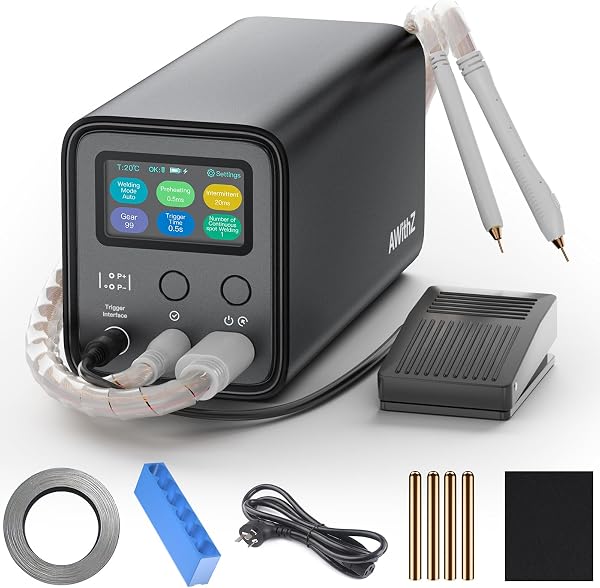
The UF20B ships as a complete kit: the main welding unit, two welding probes with cable assembly, a power adapter, and an instruction manual. Notably absent is a carry case—minor gripe, but worth knowing if you’re planning to move this between workbenches. The unit itself is compact at roughly the size of a thick paperback, with a clear LCD screen on the front panel that displays voltage and weld parameters. The probes are the standard pen-style with replaceable copper tips, and the cables are adequately thick for the current draw.
Performance and Real-World Use
Here’s where the UF20B earns its keep. The capacitor-based design stores energy and releases it in controlled pulses, which is fundamentally better than transformer-based welders for thin nickel strips. With 10 adjustable power levels and a dual-pulse mode, you can dial in settings for everything from 0.1mm nickel-plated steel to 0.3mm pure nickel strips.
In practice, this welder shines on 18650 and 21700 battery tab welding. The dual-pulse feature fires two quick bursts—the first cleans the surface, the second creates the actual weld. This matters because it reduces splatter and gives you stronger, more consistent bonds. The LCD screen shows remaining voltage and lets you monitor the capacitor charge, so you’re never guessing whether the unit is ready.
The 10.5kW peak power claim is real in the sense that capacitor welders deliver massive instantaneous current. For hobbyists building packs with pure nickel—which requires more heat than nickel-plated steel—this unit handles it without the welds pulling apart when you tug-test them.
What Buyers Consistently Praise
The dominant theme in positive reviews is the learning curve being nearly nonexistent. One reviewer noted, “First time using a spot welder and my battery tabs came out perfect on the third attempt.” Another praised the dual-pulse feature specifically: “The two-stage weld makes a noticeable difference in penetration depth—my nickel strips aren’t popping off anymore.”
The build quality also gets consistent nods. The housing feels solid, the buttons have a satisfying click, and the probe tips hold up well across hundreds of welds before needing replacement. Multiple buyers report building complete 13S battery packs without any overheating or duty-cycle issues.
Where It Falls Short
The most common complaint centers on the probe cable stiffness. In cooler environments, the cables become noticeably less flexible, which makes precise probe placement on tight battery terminals awkward. It’s not a dealbreaker—you can work around it by warming the cables or repositioning the battery—but it’s worth knowing before you buy.
The included manual is also thin on detail. It covers basic operation but doesn’t explain the ideal settings for different nickel thicknesses. Plan to experiment on scrap strips before your real project. A few reviewers also mentioned that the probe tips wear faster than expected, though replacement tips are inexpensive and widely available.
Who Should Buy This
The UF20B is ideal for three specific buyers: DIY battery pack builders working with 18650 or 21700 cells, small-scale repair technicians who rebuild power tool batteries, and hobbyists doing custom electronics projects. If you’re welding thick busbars (1mm+) or structural steel, this is the wrong tool—you need a traditional spot welder or TIG unit.
FAQ
How long does it take to charge between welds? The capacitor recharges in roughly 2-3 seconds at lower power settings, extending to 5-6 seconds at the highest output. The LCD shows the charge status, so you’ll know exactly when it’s ready.
Can it weld 0.3mm pure nickel strips? Yes, at power level 8-10 with dual-pulse enabled. Expect to test on scrap first, as exact settings vary by nickel purity and strip width.
Does it work with a car battery or only the included adapter? The UF20B uses an internal capacitor bank charged via the included AC adapter. It doesn’t require an external battery, which is safer and more portable than car-battery-powered units.
The Verdict
Buy it if you’re serious about building reliable battery packs and want a welder that’s forgiving for beginners but capable enough for advanced work. The dual-pulse technology and LCD feedback genuinely improve weld quality.
Skip it if you’re only spot-welding occasionally (a cheaper single-pulse unit will do) or if you need to weld thick materials beyond nickel strips.
Rating: 4.6/5 — The UF20B delivers exactly what capacitor welders promise: clean, consistent welds on nickel without the learning cliff. The cable stiffness and missing carry case knock off half a star, but the core performance is excellent for the price point.
Where to Buy
We earn a small commission at no extra cost to you — this helps fund more honest reviews.
Last updated: 2026-08-06. Ratings and prices current as of review date. Verify on Amazon before purchasing.
More Home Improvement Verdicts


