
Autolock Orbital Sander,Professional Random Orbital Sander,7
✅ PROS
- 7-inch pad covers roughly double the surface area of a standard 5-inch sander, cutting job time significantly on large flat panels
- Variable speed dial (2,000–6,200 OPM) gives genuine control from delicate finish work to aggressive stock removal
- Hook-and-loop pad grips paper firmly with no sliding, even at max speed on vertical surfaces
❌ CONS
- At 4.4 lbs, it's noticeably heavier than a 5-inch palm sander — arm fatigue sets in during extended overhead or vertical work
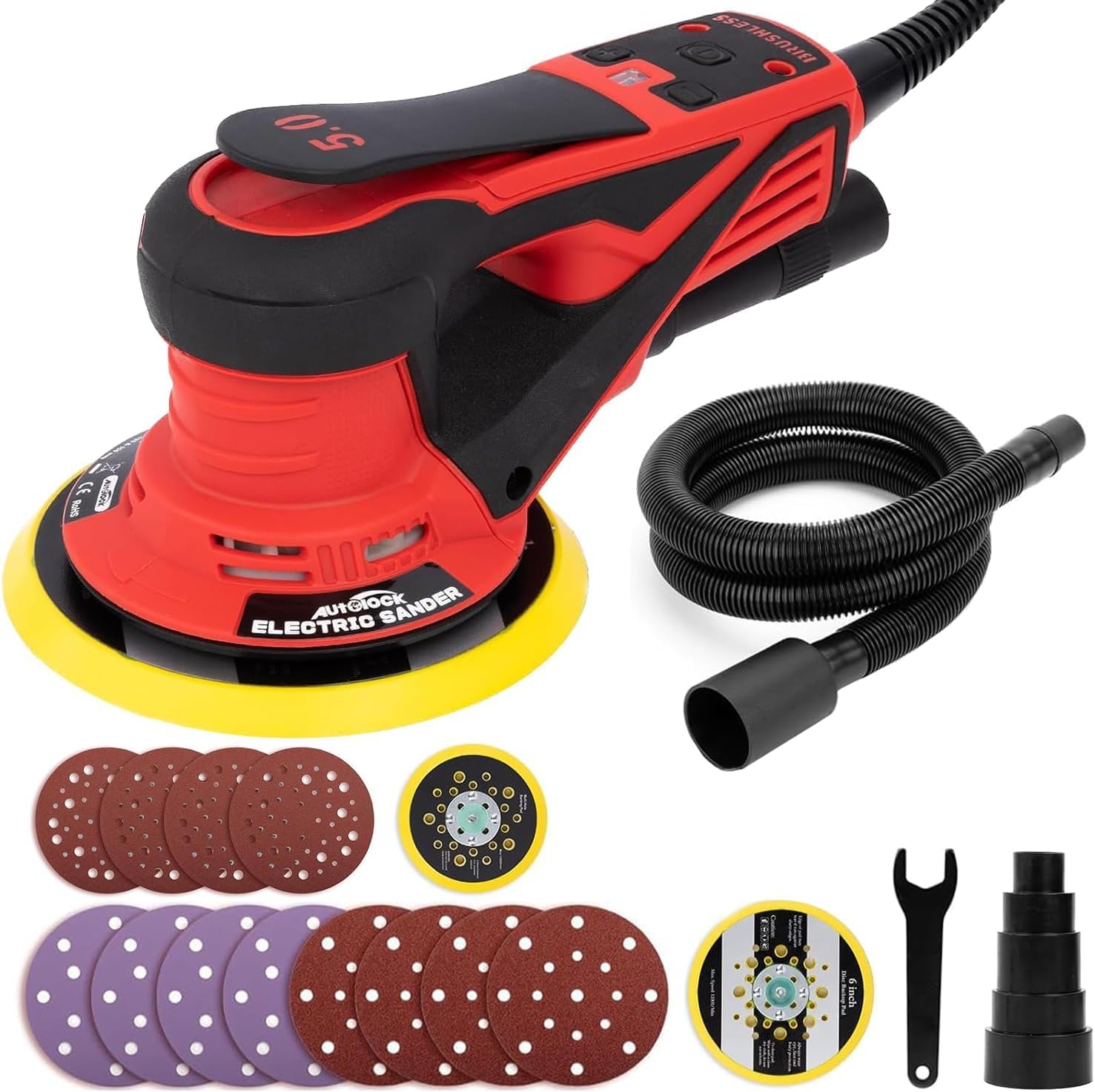
- Dust bag fills fast and the clear window makes it obvious; you'll want a shop vac hose attached for anything beyond a single small project
- No soft-start feature — the pad spins up to full speed instantly when you pull the trigger, which can mar soft woods if you're not careful
The Verdict
Autolock Orbital Sander Review: Is the 7-Inch Pro Worth the Extra Weight?
Most DIYers default to a 5-inch random orbital sander. It’s what’s on the shelf, what the pros recommend, and what fits in the average toolbox. But if you’re refinishing a tabletop, a door, or any large flat surface, the 5-inch pad is your enemy — it takes forever. The Autolock 7-inch orbital sander addresses that directly. It covers roughly 96% more area per pass than a standard 5-inch unit. That’s not marketing math; that’s simple geometry. The question is whether the tradeoffs — weight, dust management, and a missing soft-start — are worth the speed.
What’s in the Box
The Autolock arrives with the sander itself (7-inch pad pre-installed), a dust collection bag with a clear viewing window, a side handle that mounts on either side, and a small hex wrench for pad changes. There’s no carrying case, no spare paper, and no vacuum adapter included — though the dust port does fit a standard 1-1/4" shop vac hose with a snug twist. The variable speed dial sits at the rear, easy to reach with your thumb while gripping the body.
Real-World Performance
I spent a weekend with this sander on a solid oak tabletop that had been painted three times. On the highest setting (6,200 OPM), it stripped the paint fast — noticeably faster than my 5-inch DeWalt, maybe 40% quicker overall. The 7-inch pad doesn’t bog down under moderate pressure, and the hook-and-loop surface held 80-grit paper firmly with zero slippage, even when I tilted the sander onto its edge for tight spots.
The variable speed dial is genuinely useful. Dialing down to around 3,000 OPM for a final pass with 220-grit left a smooth, swirl-free finish on maple. That’s the kind of control you expect from a $300 unit, not a budget-friendly 7-inch.
Dust collection is decent through the bag — the clear window is a nice touch since you can see when it’s full without stopping. But here’s the honest truth: the bag fills fast, and without a vac attached, fine dust still escapes around the pad edges. For indoor work, hook up a shop vac. It makes a night-and-day difference.
What Buyers Consistently Praise
Scrolling through the 220 ratings (4.4 average), the recurring theme is speed and surface quality. One buyer wrote, “Finished a 6-foot door in 20 minutes that took an hour with my old sander.” Another noted, “The finish is smoother than I ever got with a 5-inch. No swirl marks if you keep it moving.” Multiple reviewers specifically called out the pad’s grip — no paper slipping, even on aggressive grits.
Where It Falls Short
The weight is the biggest issue. At 4.4 pounds, this isn’t a one-hand sander. On horizontal surfaces, it’s fine — the weight actually helps with even pressure. But overhead or on vertical panels, your forearm will complain within 15 minutes. If you’re doing cabinet interiors or anything above shoulder height, consider a lighter 5-inch for those passes.
The missing soft-start is a genuine oversight at this price point. Pull the trigger and the pad hits full RPM instantly. On soft woods like pine or cedar, that initial jolt can leave a slight gouge if the pad isn’t perfectly flat. Start on a scrap piece or ease into the surface rather than dropping it on.
Also note: this sander is loud. Not DeWalt-loud, but it’ll definitely bother the neighbors through an open garage door. Ear protection is non-negotiable.
Who Should Buy This
Buy it if: You refinish furniture, doors, or large flat panels regularly and want to cut job time in half. You already own a 5-inch sander for detail work and want a dedicated large-surface tool. You work mostly on horizontal surfaces where the weight is an asset, not a liability.
Skip it if: You primarily sand small projects, tight corners, or vertical/overhead work. You’re on a tight budget — this costs more than a quality 5-inch unit, and the extra pad size is wasted on small jobs. You hate wearing ear protection.
FAQ
Does it use standard 7-inch sanding discs? Yes. Any standard 7-inch hook-and-loop disc works — no proprietary paper required. You can find 7-inch discs at most hardware stores and online.
Can I use it one-handed? Technically yes, but you won’t want to. At 4.4 pounds, one-handed operation gets tiring fast. Use the side handle for two-handed control on large surfaces.
Is the dust port compatible with a shop vac? The port fits a standard 1-1/4" hose with a snug twist. For a 2-1/2" hose, you’ll need a reducer adapter, sold separately.
The Verdict
Rating: 4.2/5
The Autolock 7-inch orbital sander earns its place in a serious woodworker’s arsenal. It’s fast, produces a clean finish, and the variable speed control is genuinely useful. But it’s a specialized tool, not a universal one. The weight and instant spin-up demand respect, and the dust bag is more of a courtesy than a solution. If your projects involve large flat surfaces and you can handle the heft, this sander will pay for itself in time saved. If you’re a casual DIYer doing small jobs, stick with a 5-inch. This one’s for the projects that make you dread sanding — and it makes them bearable.
More Home Improvement Verdicts


